
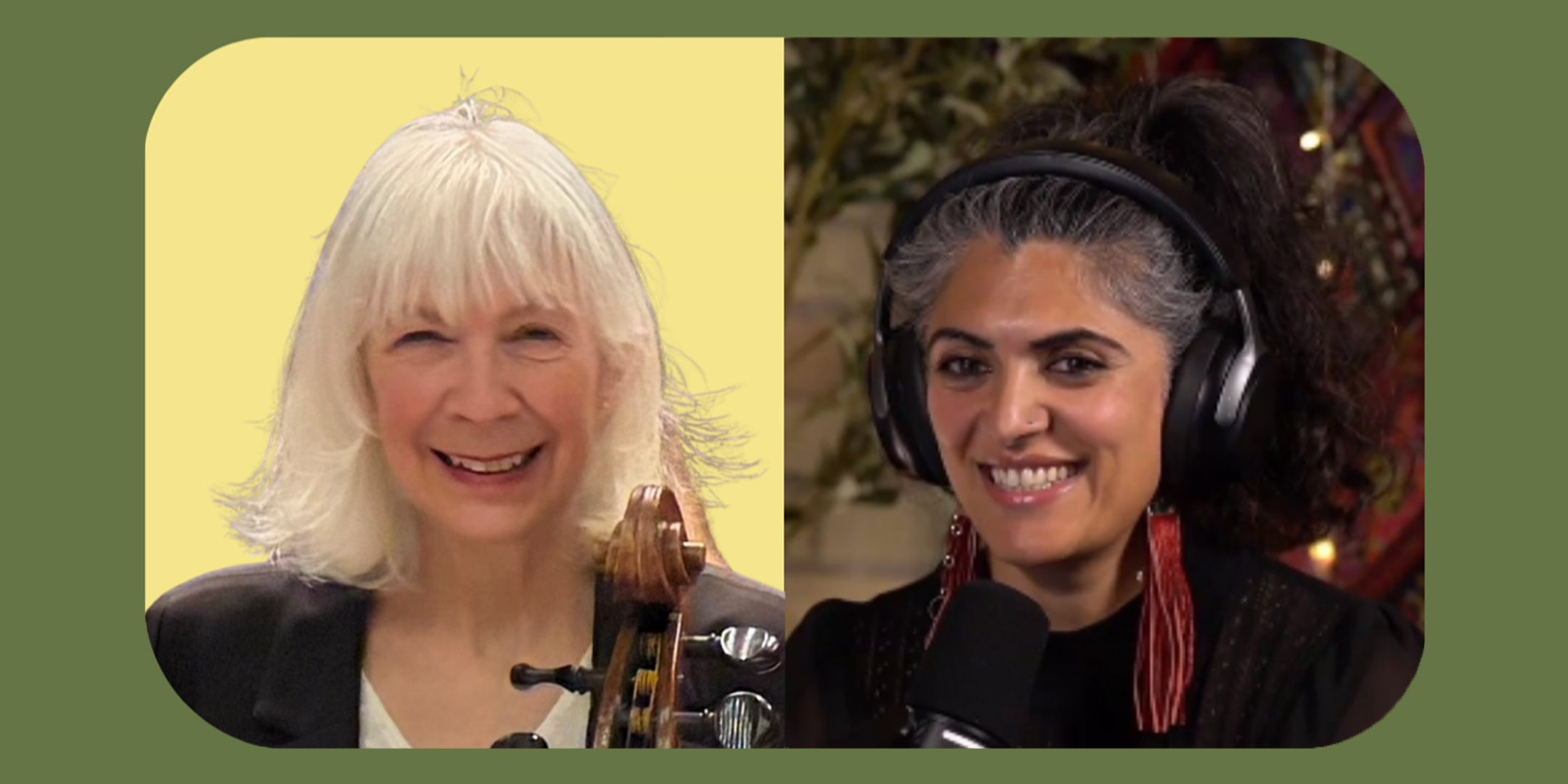
A few weeks ago, I had the privilege of sitting down with Rabbi Donna Kirshbaum for an episode of Between The Threads.
We spoke about many things that afternoon. Childhood. Shame. Storytelling. Synagogues. Women. Peace. Israel and Palestine. Our conversation from that day has rattled in my being. It has mobilized many other conversations.
What Makes a Place Sacred?
As we meandered through topics, at one point I asked Rabbi Kirshbaum what makes a place sacred.
We all know that ain't a straightforward question. Donna responded by drawing a distinction I had never really considered before. She spoke about the difference between a heart connection and a soul connection. The heart, she reflected, is capable of many things. It loves. It grieves. It forgives. It resents. It changes. Hearts, by their very nature, move. But a soul connection belongs somewhere else entirely. It lives beneath explanation. It is the sort of relationship where every word we reach for somehow feels inadequate, where language itself begins to fall short of what we know to be true.
I've been carrying that distinction with me ever since. And the more I thought about it, the more I realized that I've actually spent much of my own life trying to describe something that perhaps was never meant to fit neatly into language.
Whenever I return to Lahore, there is a particular moment as the aircraft begins its descent. I know it before I see it. My breathing changes. My attention sharpens. The landscape begins to emerge beneath the clouds, and something inside me responds before my mind has caught up. I have yet to experience it without tears in my eyes. Happens every single time I fly home.
How do I explain that feeling that lies in the middle of joy, grief, relief, longing, anger...and perhaps...simply home. That feeling is all of these things at once, and somehow none of those words alone or together feel sufficient.
Over the years, I've written often about my relationship with Punjab and Kashmir, about Partition, memory, migration, and the complicated inheritance that so many of us carry. I've always assumed I was trying to describe belonging. Now I wonder if I was trying to describe something even deeper.
If I think along the lines of the wisdom Raabi Kirshbaum offered that afternoon, perhaps I was trying to describe a soul attachment.
That realization has stayed with me because so much of my work as a planner and peacebuilder asks me to sit with people's relationships to land. We often approach these conversations through the language we've inherited: ownership, jurisdiction, borders, governance, rights, history, evidence. All of these things matter deeply. They absolutely do. And yet I wonder whether they are sometimes answering a different question than the one people are actually trying to ask.
What if, when someone speaks about territory, they are actually speaking about sacredness? Or when they talk politics, they are actually speaking about memory? And what if what we hear as competing claims are, for the people living them, expressions of profound soul attachment?
As our conversation continued, Rabbi Kirshbaum spoke about how she believes both Israelis and Palestinians hold soul connections to the same land. She offered that thought in a way I can only describe as deeply human. She didn't erase memory, erase history, didn't flatten injustice. She didn't suggest difficult questions suddenly disappear if we just become more compassionate. Instead, she invited something much harder.
Her words invited the possibility that more than one sacred relationship can exist at the same time.
Rumi. Rumi's field of the field. You've heard me talk about it a million times. In that moment, as I listened to her wisdom, I was totally in the field.
That idea of more than one sacred relationship feels incredibly important, not only for Israel and Palestine, but for so many conflicts around the world. As negotiators, planners, and peacebuilders, we often spend enormous amounts of energy trying to determine whose narrative is correct, whose evidence is stronger, whose claim is more legitimate. Those questions matter. They shape policy, law, and governance. But it doesn't end there.
Perhaps we also need to become better at recognizing sacredness without immediately trying to rank it.
And that, my friends, feels like a whole new level of listening. I'm asking myself an honest question here. Can I truly strip my own biases to be able to recognize sacredness without ranking it? Maybe that's the real work here.
Why Women in Peacebuilding?
Later in the conversation, we reflected on Women Wage Peace, and on Carol Gilligan's work around what she calls the human voice. As Donna described it, I found myself thinking about the many women I have met across negotiation tables, in communities, in kitchens, and around shared meals. Women who have spent much of their lives navigating contradiction. Women who have learned to hold several truths at once without feeling compelled to reduce them into something simpler.
Now this isn't because women are somehow naturally better at peacebuilding (that would be too simple). We talked about how its probably because we've had to become fluent in complexity simply to move through the worlds we inherit. Worlds where we inherit a whole lotta chaos and very little decision-making authority. And negotiating that authority costs so deeply, that by the time we survive it all and land on the other side, we're likely marinated in complexity ourselves.
To me, this is one of the gifts women bring to conflict transformation. Not certainty. And certainly not perfect answers. But a remarkable capacity to remain present with complexity long enough for something deeper to emerge.
"Anti-Arrogance Spaces"
When I asked her how she would describe synagogues, Rabbi Kirshbaum described synagogues as "anti-arrogance spaces." I smiled because I was reminded of something my Daada Jaani used to say.
"The higher you rise, the lower your head should bow."
I have carried those words with me into boardrooms, negotiation tables, community halls, and conference stages. Over time, I've come to realize that humility is not about making ourselves smaller. It is about remembering that we are always standing before something larger than ourselves. Sometimes that something is history. Sometimes it is another person's grief. Sometimes it is a land that has held generations before us. Sometimes it is simply the recognition that we will never fully understand another person's soul attachment, no matter how carefully they try to explain it. And that is a whole different level of humility of the self.
And perhaps that is where stories become so important.
At Kahanee, we often speak about stories as bridges between people. After this conversation with Rabbi Kirshbaum, I wonder if stories are something even more profound than that. Perhaps stories are among the few places where sacredness can simply exist without being interrogated. Where complexity doesn't need to be resolved before it can be accepted. Acknowledged. Where another person's love for a place doesn't threaten our own.
Where soul attachments can be witnessed, even if they can never be fully explained.
If that's true, then perhaps storytelling is not simply an act of remembering. Perhaps it is one of the quietest forms of peacebuilding we have.
And perhaps peace itself begins not when we finally agree about a place, but when we learn to recognize the sacredness someone else has always known was there.
So darn grateful to Rabbi Kirshbaum for her soul-wisdom. If you'd like to listen to the full episode, please visit https://open.spotify.com/episode/1ebLbnHgY5yfW5r7tJsNDZ?si=6a7a78da2a6742ae or any other platform where you get your podcasts. This one is titled The Story of a Sacred Place.


